If you walk into any agricultural machinery shop or talk to experienced farmers, you’ll hear this question again and again:
“Should I use a rotavator or a cultivator?”
At first glance, both tools seem to do the same thing. They work the soil before planting. But in reality, they serve different purposes, and choosing the wrong one can affect soil health, fuel consumption, and even crop yield.
Let’s break it down in simple terms so you can understand when to use a rotavator and when a cultivator makes more sense.
First, What Does a Rotavator Do?
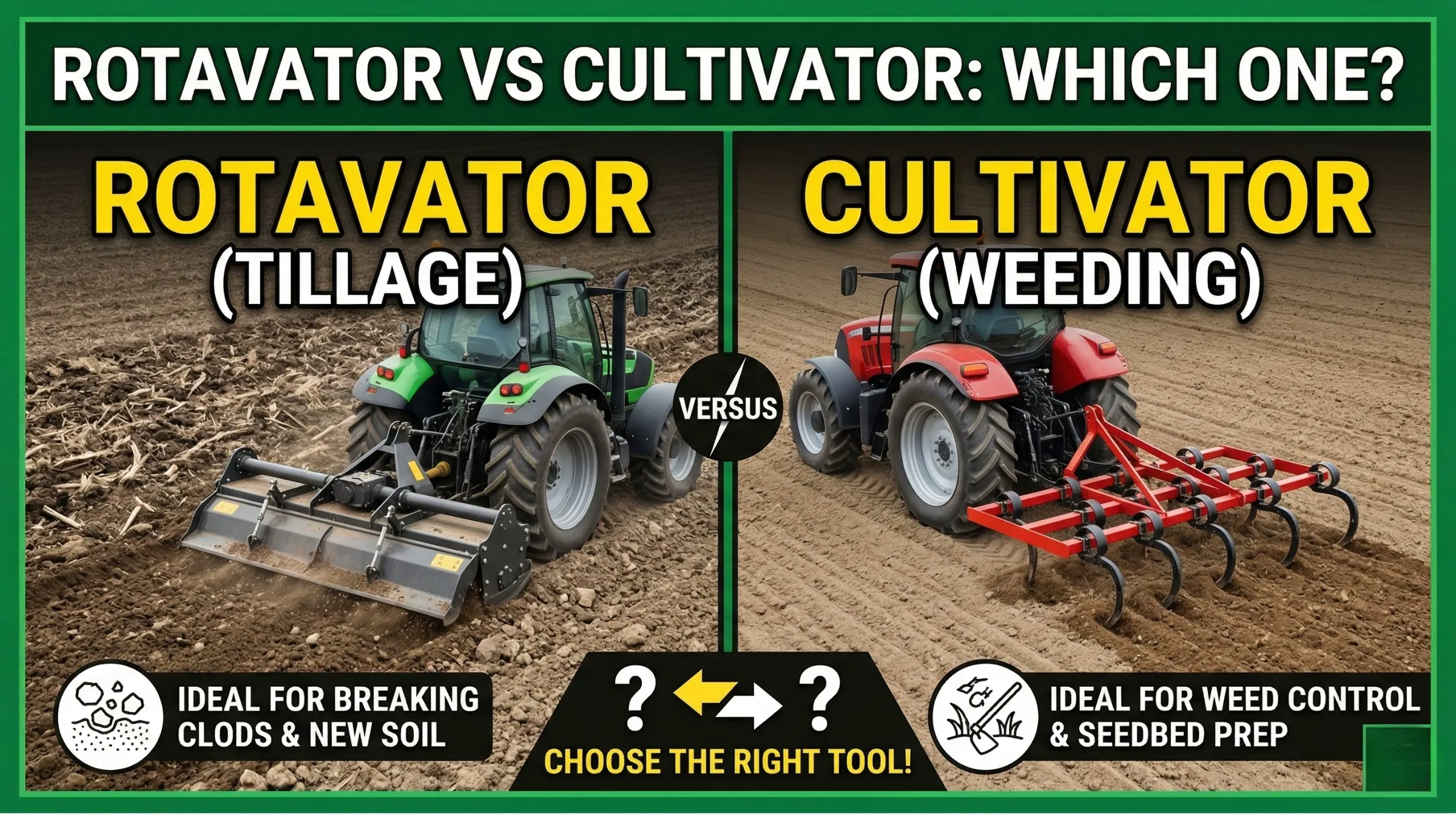
A rotavator (also called a rotary tiller) is designed to break, mix, and prepare soil in one pass.
It uses rotating blades attached to a rotor that spin rapidly and cut into the soil. As the blades rotate, they break clods, mix crop residue, and level the soil.
In simple words, a rotavator pulverizes the soil.
Because of this aggressive soil action, rotavators are commonly used for:
- Fine seedbed preparation
- Mixing crop residue into the soil
- Breaking hard soil after ploughing
- Preparing land for vegetables and short-duration crops
One of the biggest advantages of a rotavator is speed. It can prepare land quickly with fewer passes compared to traditional implements.
But speed isn’t everything.
Overusing a rotavator can also compact soil layers below the surface, which is something many farmers don’t realize.
Now, What Does a Cultivator Do?
A cultivator works differently.
Instead of rotating blades, it uses tines or shanks that dig into the soil and loosen it without completely pulverizing it.
Think of it as soil loosening rather than soil grinding.
Cultivators are commonly used for:
- Breaking soil after ploughing
- Weed control between crop rows
- Aerating the soil
- Maintaining soil structure
Unlike rotavators, cultivators do not overwork the soil.
They leave the soil more open and structured, which is often better for long-term soil health.
Another advantage is lower power requirement. Cultivators generally require less tractor power and consume less fuel.
The Real Difference Between Rotavator and Cultivator
Here’s the simplest way to understand it.
A rotavator prepares the final seedbed, while a cultivator prepares the soil before that stage.
If we compare their function step-by-step:
- A cultivator loosens the soil
- A rotavator refines the soil
Both tools are useful, but they are used at different stages of land preparation.
When Should You Use a Rotavator?
A rotavator is the right choice when:
- You need fine soil for sowing
- Crop residue needs to be mixed into the soil
- You want to reduce multiple tillage passes
- You are preparing land for vegetables or seedbeds
For example, after using a plough or cultivator, a rotavator can quickly prepare the final soil structure needed for planting.
That’s why many farmers use a rotavator as the last step before sowing.
However, it’s important not to rely on rotavators for every operation. Excessive use can make soil too powdery and reduce natural soil structure.
When Should You Use a Cultivator?
A cultivator works best when:
- Soil needs primary loosening
- You want to maintain natural soil structure
- Breaking hard soil layers after ploughing
- Weed control between crop rows
In large fields, cultivators are often used as the first implement after ploughing.
They prepare the field for the next stage of land preparation without disturbing soil biology too much.
Because cultivators require less power and fuel, they are also a cost-effective option for regular field operations.
Can Rotavator Replace a Cultivator?
This is where many farmers make mistakes.
Technically, a rotavator can perform some of the tasks of a cultivator.
But using a rotavator instead of a cultivator all the time is not always a good idea.
Why?
Because rotavators work aggressively on the soil. Continuous use can create a compact layer below the working depth, often called a hard pan.
Over time, this can affect root development and water infiltration.
That’s why many agricultural experts recommend combining both tools instead of replacing one with the other.
The Best Approach: Use Both at the Right Time
The smartest approach is not choosing one tool over the other.
It’s using both implements at the right stage.
A typical sequence looks like this:
- Ploughing – to break the soil deeply
- Cultivator – to loosen and aerate the soil
- Rotavator – to prepare a fine seedbed
This combination gives you the best results while maintaining soil health.
Final Thoughts
Rotavators and cultivators are both valuable tools in modern farming. But they are designed for different roles in soil preparation.
A cultivator helps loosen and maintain soil structure, while a rotavator helps refine and prepare the final seedbed.
Understanding when to use each tool can improve efficiency, reduce fuel costs, and support better crop growth.
And in farming, those small decisions often make a big difference in the long run.